Posted in Keep Moving: Motivation and Inspiration, Love, Mental Health, Other Publications, Potential and Worth, Power, Self-Care, Self-Talk

Building and Maintaining Personal Boundaries

What is a Boundary?

A boundary is a limit or rule we set for ourselves to honor our inner and outer well-being. Whether that boundary is to protect ourselves, to reserve energy, resources and money, to stop ourselves from the urge to continuously give or “save” another, or simply to respect our personal goals and self-worth, it’s essential to build and maintain personal boundaries.  

Personal boundaries are what separate us from giving too much of ourselves to things, people, and situations that do not serve our growth and progress. While it may appear ideal to be able to do everything and anything without limits, we cannot and should not exhaust ourselves of our personal needs.  We are responsible for what we allow. Whether in relationships (familial or romantic), with friends, at work, or anywhere where we are interacting with others, practicing boundaries helps us to be in tune with ourselves and our values.      

Something to Remember: We are not perfect and cannot do everything or please everyone at the expense of our mental, physical, or emotional well-being. 

How can we, therefore, set boundaries that will help us prioritize our needs?  

Self-Awareness and Boundary Setting

Increasing self-awareness is an important step when building and maintaining personal boundaries. The more we know who we are and what we are okay with, the more we can establish and sustain boundaries that serve us best. Understanding the balance between too much, too little, and the right amount of energy and effort can push us in the right direction in creating healthy boundaries.      

Here are some questions you can ask yourself that will help you reflect and understand whether you need to set stricter boundaries:

  • How do I feel?
  • How would I rather feel?
  • Should I say no?
  • Do I have time to spare?
  • Does this make me feel uncomfortable?
  • Is this benefiting me? 
  • Am I overexerting myself?
  • Do I need to do this? 
  • Do I want to do this?
  • Can I do this?
  • Do I need time for myself? 
  • What is okay/not okay for me to do/say?
  • When do I speak up? 
  • Does something need to end? 
  • What can I change?
  • What do I have control over? 

Getting into the habit of asking questions is not only a good idea for self-awareness, but also for increasing confidence. Becoming reflective in understanding what we deserve and in what we will tolerate will also aid in a better understanding of self-worth. 

How Boundaries Help Strengthen our Mental Health

Boundaries allow us to build a stronger connection with ourselves. Understanding who we are will help us to become more centered and mindful of what is happening around us and to us.  Stern boundaries will also help us to prioritize self-care, become more direct and open as well as vocal about our needs, beliefs and values.  Being able to say no and express how we feel will give us the autonomy we need to improve our sense of self-worth.  We will feel more comfortable expressing ideas and thoughts without shame, embarrassment, or hesitation. 

Healthy boundaries can look like saying no when necessary, balancing self-care with work, cutting ties with toxic people and situations, speaking up without feeling like a burden, putting your needs before anyone else’s unapologetically, accepting that you cannot change or save anyone and not trying to, and giving yourself permission to feel and reflect without the opinion of others.  

Affirmations to help Maintain and Sustain Positive Personal Boundaries:

  1. I set standards for myself and will stick to them.
  2. I know who I am and what is good for me.
  3. I understand my personal boundaries.
  4. I honor myself and my boundaries.
  5. I have a right to my feelings.  
  6. I can firmly state my boundaries.
  7. I am confident in my ability to set boundaries with others.
  8. I will say no when necessary.
  9. I am safe.
  10. I am in control of my life.

Next Steps and Final Thoughts

As we move into a space of self-acceptance and self-awareness remember to honor your boundaries and give yourself permission to grow and reflect on your needs. Continuously grow in your boundaries in love and compassion for yourself.   
 

Posted in Keep Moving: Motivation and Inspiration, Love, Mental Health, Other Publications, Potential and Worth, Power, Self-Care, Self-Talk

Building a Brand: Creative Self-Care and Writing to Heal

This is my writing story. How it started…

Finding My Voice: SparklyWarTanks

I started blogging in 2015 following a class project in my senior year of college. Unaware of the impact writing will have on my mental health, I maintained a steady habit. When I felt anxious, depressed or even inspired and ready to take over the world, I wrote something. No matter the circumstance or situation, I continued to write. I called this new ignited excitement for writing SparklyWarTanks, a phrase that combines the ideas of being “pretty and ”together” with also being at ”war” and ”struggling.”

SparklyWarTanks became an extension of me⁠, who I wanted to become and the perspective I wished to build. My everyday writing changed and transformed into therapy writing; writing about pain, acceptance, identity, and struggle. I wrote to feel free, to challenge myself, and to improve my mental wellness. Writing gave me strength, peace, and my own voice.  

Finding My Voice: Asking Important Questions 

As SparklyWarTanks progressed during the first year, themes and patterns emerged in my writing style. I began to write mental health articles along with my motivational and creative content. Eager to build a more stable and workable sense of self, I felt refreshed when my imagination flooded with ideas. 

To keep the content flowing, I often asked myself important questions. Whether these questions were related to me directly, or for my target audience to grapple with (mostly young adults, especially women, figuring themselves out), my goal was to challenge notions of self-development and self-acceptance. I wanted to construct a progressive view of growth. 

Some of the questions were, but not limited to:

  • How do I feel?
  • How do I want/deserve to feel?
  • Who am I? 
  • Who am I becoming?
  • What do I want to achieve? 

Through writing, I began to create and mold myself while also advocating for a communal and collective sense of awareness for my readers. As a community, what do we need to do to improve how we see ourselves? I wanted to help others while also helping myself. I wanted my growth to help others grow as well.   

Continuing in the present…

Writing and Creative Expression: Creativity and Mental Health 

Progressing in my writing craft and finding who I want to be through my projects and perspective is nothing short of soul-satisfying.  Writing and creative expression not only helps me build a new perspective on growth, vulnerability, and self-awareness but also helps me manage my depressive and anxious symptoms as well. The more I write and ask myself important questions, the more I’m able to identify my t riggers and heal through them.


Different genres and approaches I experiment with in my writing include: 

  • Affirmations/Declarations
  • Motivational Quotes
  • Bulletins
  • Notes
  • Poetry 
  • Activities 
  • Challenges 

Topics such as self-talk, self-care, self-love, self-worth, power, reflection and potential guide my views and shift how I think, especially during the tough days.  I write to think through what I believe; I write to build and create my truth. Mental

health and self-development now connect with one another. How I want to feel includes taking care of myself physically, mentally, and emotionally. 

Are you thinking of starting a writing habit?

Next Steps: You Can Write Too

Writing can be for all of us. Whether for fun, to vent, or to get your thoughts onto something and out of your head, writing can help! Writing can be whatever you make of it. If it’s to share or to keep to yourself, whatever you create is something to be proud of.

Consider these questions when starting to write:

  • Why am I writing?
  • What do I want to write about?
  • What do I want to say?
  • Who do I want to say it to?
  • What overall message do I want to portray?   

Need help? You can check out my SkillShare class to get started!

Posted in Keep Moving: Motivation and Inspiration, Mental Health, Other Publications, Potential and Worth, Power, Self-Care, Self-Talk, Tips

How to Bounce Back from a Panic Attack

Experiencing a panic attack is exhausting, draining and can take days to recover from. While we sometimes do our best to prevent an escalation into a panic attack, they still can happen. How do we feel like ourselves again following a panic attack? What are some positive coping techniques we can use to improve our self-care?

Resting and Relaxing

Resting and relaxing helps rejuvenate lost energy after experiencing a panic attack. Taking time to recuperate allows us to clear our minds and take the necessary steps to recover. 

Resting may look like:

  • Taking it easy. 
  • Asking for help with chores or errands. 
  • Taking a break from demanding responsibilities.
  • Prioritizing time alone or with trusted family and friends.

Giving ourselves permission to slow down assists our recovery process and opens our perspective to the best methods of self-care.

Mindfulness

Mindfulness is the skill and habit of focusing awareness on the present moment. The better we become at cultivating nonjudgmental awareness of our thoughts, feelings, environment, and experiences from moment to moment, the more we can learn about ourselves and our stressors. Mindfulness teaches us to notice, accept, and let go rather than dwell and latch onto past thoughts or future worries. 

Mindful Daily Activities

Along with resting and relaxing, it’s also beneficial to practice mindfulness while doing everyday activities like eating, drinking, walking, etc. Becoming mindful while engaging in daily activities enables us to clear our minds only to focus on how we are interacting with our environments and ourselves during each moment. 

Tip: To eliminate worry, center the senses in current activities rather than what can happen in the future or what happened in the past. Ask yourself what is happening in the here and now.

Mindful Meditation/Controlled Breathing: Sitting in quiet spaces practicing mindful meditation and controlled breathing are also useful coping mechanisms to calm the mind and body. Creating a rhythm of breaths, inhaling and exhaling for the count of five for example, while also clearing our minds of worry helps in recentering focus and control. 

Reminder: Mindfulness reinforces our ability to gain control and restore our inner wellbeing.

Reminders and Positive Self-Talk

Accompanying mindfulness is reminders and positive self-talk to further empower our inner sense of security. Reminding ourselves that we are safe and in control helps us move past our fears and into a calmer state of mind. 

Some self-soothing affirmations to try include:

  • I am safe. 
  • I am in control. 
  • I can ask for help if I need to. 
  • I release my fears and worries. 
  • I am powerful and in control of my decisions. 

Note:  Positive self-talk increases confidence and supports inner strength despite discouraging feelings of doubt and fear. 

Identifying Triggers

Our triggers can hinder us from wanting to do the activities we love or want to try. Like mindfulness and positive self-talk, building self-awareness helps us learn more about ourselves and what overwhelms us. One way we can gain self-awareness is by asking important questions. 

These questions can be:

  • What caused this panic attack?
  • What can I do to prevent possible future spirals and escalations?
  • What are my next steps?
  • How am I feeling right now? 
  • Who can I go to for help?
  • What tools and resources are available to me?

Recognizing and identifying our limits as well as creating boundaries can help us take better care of our mental health. Understanding who we are and what triggers us is a necessary step to preventing future escalations of overwhelm. 

Tip: Journaling/Writing can be a helpful tool when attempting to reflect and process what happens after experiencing a panic attack. 

Communication

Once we’ve gained some energy and given ourselves time to rest and reflect, we can communicate with others we trust about our experience. This step can be taken during or after our reflection time as processing can look different for everyone. 

Reminder: Remember to be gentle communicating experiences with others. Panic attacks do not make anyone a failure or stop any of us from enjoying life or taking risks.

Creativity

Utilizing creativity is not only engaging but can help in the reflection process following a panic attack. We can supplement how we communicate our experience with creative expression.

Asking important questions about an experience can be difficult but using creative prompts in poetry or art can catalyst that process. 

Expressing ourselves creatively can be in the form of:

  • Poetry/Creative Writing 
  • Painting 
  • Digital Art

With creative prompts like: 

If you can describe, craft, or create a physical description of the anxiety or feelings following a panic, what would it look like? Would it be a person, place, or thing? Does it have weaknesses and strengths? What is it’s vulnerable points? 

Write a letter to the anxiety that leads you to feel overwhelmed. What would you say to it?  

Imagine a tree with its roots. Imagine the tree is you. List everything that makes you strong and firm and put them at the roots of the tree. Now, list all of your accomplishments, talents, things that help you keep going and name them on the branches of the tree. As a reminder of all that you are and motivation to move forward, create your tree of life.  

Along with using creativity to help process our experiences, we can also use creativity to distract and calm ourselves too. Learning a new craft is both rewarding and fun! 

A new craft to try can be:

  • Sewing 
  • Crocheting 
  • Crafting jewelry 
  • Making keychains 
  • Designing and making stickers. 
  • Sculpting 

Next Steps

Now that we’ve learned some tools to bounce back from a panic attack, what techniques are most helpful for you?  Self-care is different for all of us so what helps some might not help others and that’s okay! What’s important is feeling better.

Never forget that we are still capable, strong and worthy of whatever we set our minds to despite experiencing moments of panic. 

Posted in Keep Moving: Motivation and Inspiration, Love, Mental Health, Potential and Worth, Power, Quotes, Self-Care, Self-Talk

A Powerful Affirmation: Choosing Calmness

The choice to be calm is a talent. Even with all that goes on in my head, and the worry that sometimes consumes my thoughts, I CHOOSE to be gentle, mindful, and calm.

With each day, I allow myself to reflect, take what I need, let go of what I don’t, and move on with grace.

I will not panic.

I will not worry.

I will not stress.

I will map out my next steps and take one moment at a time.


Find it on The Mighty here.

Posted in Keep Moving: Motivation and Inspiration, Love, Mental Health, Potential and Worth, Power, Quotes, Self-Care, Self-Talk

I’m a Recovering People-Pleaser

This Sticker will be available this week on Etsy.com/shop/MotivateBySWT

For 2020 and beyond I am prioritizing self-care and self-love that is defined by me and only me. With each week reflecting on various ways to reflect and process my feelings, this week is redefining my worth to MYSELF.

Having a past of people-pleasing is hard to realize and even harder to overcome. Not seeing myself as valuable or worthy of love has influenced a history of constant “doing” in order to prove myself to those around me.

This habit ends now.

So, I’m saying no to:

  1. What is not for me.
  2. What makes me uncomfortable.
  3. What doesn’t serve my needs.
  4. What I don’t have the energy for.
  5. Being available to everyone.
  6. Feeling unimportant.
  7. Giving away all of my energy.
  8. One-sided interactions.
  9. Seeking validation.
  10. “Fixing” other people’s problems.

And, I’m saying yes to:

  1. What fills me with joy.
  2. Solid boundaries.
  3. Building lasting connections.
  4. Healthy vulnerability.
  5. Feeling good about myself.
  6. Expressing my needs.
  7. Allowing myself to be seen.
  8. Reaching out to others.
  9. Being happy.
  10. Feeling peace.
  11. Doing things for fun.
  12. Smiling.
  13. Being open to love.

Affirmation: I am open to loving myself unconditionally and unapologetically.

Posted in Keep Moving: Motivation and Inspiration, Love, Mental Health, Potential and Worth, Power, Self-Care, Self-Talk, The Mighty, Tips

January 1st Check-In: New Year New Habit

I woke up pretty sad today. My thoughts are filled with doubts, fears, and hopelessness. What I am going to do this year, however, is allow myself to feel the tough stuff and process my emotions 💡.

My new year’s new habit will be to journal every day and help myself to heal and feel. No matter how low I get, I will allow myself time to get through the hard stuff without pushing it away.

Goal: Love me enough to find productive ways to process my thoughts and feelings.

What are some habits you’ll like to start in 2020?.


Find it here on my Mighty Page.

Posted in Keep Moving: Motivation and Inspiration, Mental Health, Potential and Worth, Power, Quotes, Self-Care, Self-Talk

You Did That

Even in the toughest moments, in those moments where you wanted to give up, you didn’t, you pushed through. YOU DID THAT.

You are powerful.

Give yourself credit for maintaining the strength and stamina to get up every time you were knocked down.

Remember that you are strong even if you don’t feel like you are. You are brave and powerful even if your mind constantly tells you you’re not.

You are not broken. You are being built to withstand whatever else might try to get in your way.

Just know, it doesn’t have a chance.

If no one told you already, I am so so proud of you.

Posted in Defying Shadows Articles, Keep Moving: Motivation and Inspiration, Mental Health, Other Publications, Potential and Worth, Power, Self-Care, Self-Talk, Tips

Defying Shadows: Weird Tricks that Really Do Help you Fall Asleep

Anyone else have issues with falling asleep? Here are some tips and tricks I learned in my Defying Shadows Article!

Weird Tricks that Really Do Help You Fall Asleep

What are some helpful techniques you use to fall asleep?

Posted in Confessions, Keep Moving: Motivation and Inspiration, Love, Mental Health, Potential and Worth, Power, Reflection, Self-Care, Self-Talk, What Just Happened: Personal Anecdotes

Therapy Takeaways: Reclaiming Self-Love Through Passion

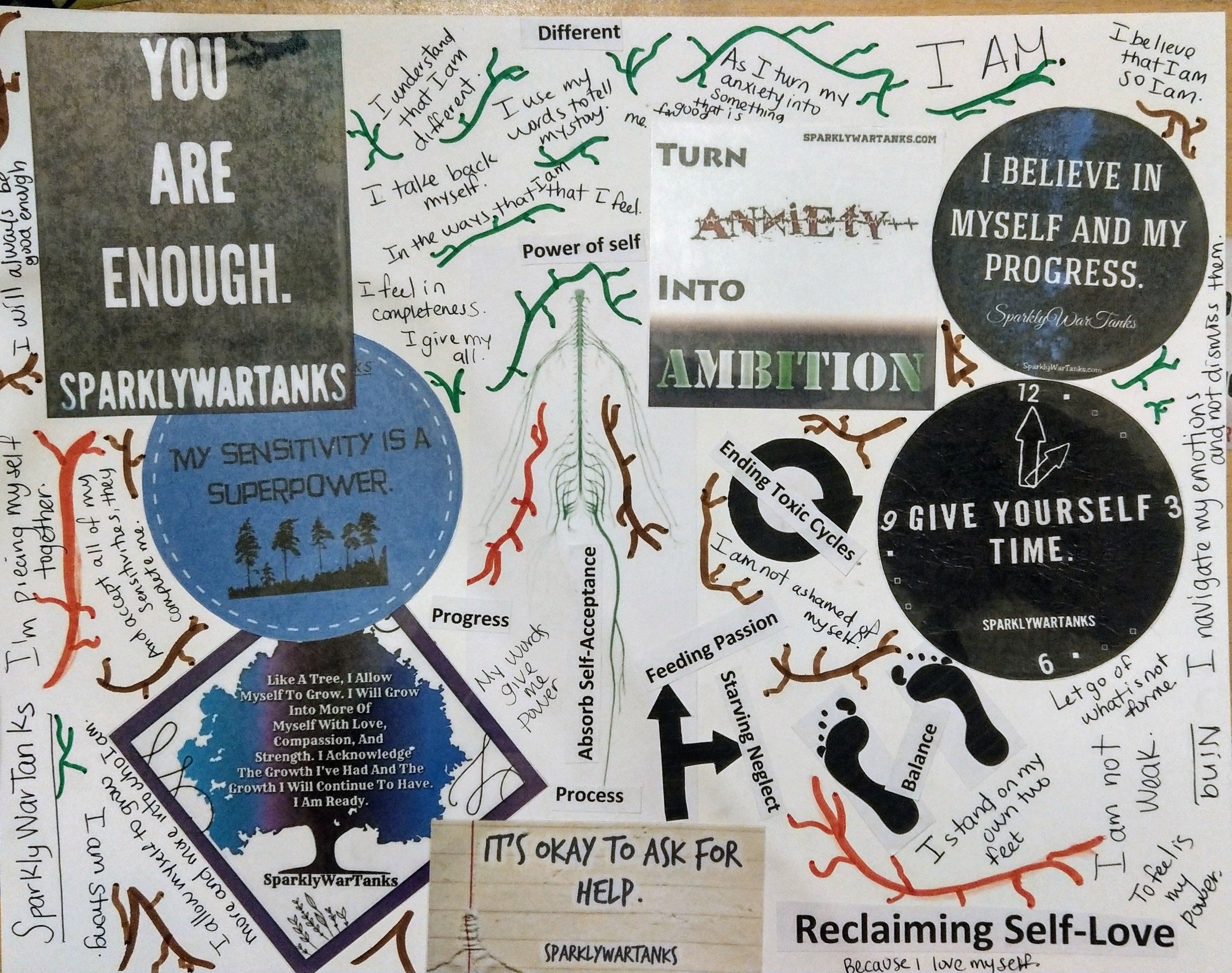
A collage depiction of what self-love looks like inside of me, traveling through my veins.

Going Back to Therapy

For the last month and a half or so I’ve been seeing a therapist for the first time since that one semester in my senior year of college. Although it’s difficult to manage all the emotions that come up as I talk through all of “my stuff”, I’m continuing to come in contact with the parts of me that were previously tucked deeply away. The more I talk and navigate my experiences, the more I’m able to identify the parts of me that need healing.

In these few weeks I learned three big things about my personality, habits, and tendencies:

1. I’m a highly sensitive person and a hopeless romantic.

2. I have issues with feeling good enough and loving myself in the same intensity that I love others.

3. I’m a recovering perfectionist and still struggle with “doing” too much to feel seen. I try to “stay busy” in order to distract myself from feelings unlovable, worthless, and enough. I crave outside stimuli to try to fill a void inside.

The Creative Cure

As I’m learning about what it means to be me, the good and the bad, I found that creativity and writing are my most helpful tools for feeling better.

Because I’m aware of my perfectionism, I’m trying to reverse and redirect the energies I put in “doing”, “pleasing” and “overexerting” back into myself. As I practice what feeds my passion, I’m beginning to realize what love means for me. The more I see what love is for me, the more I can pour back into myself the void of practicing and feeling self-love.

Passion and Learning Self-love

Passion is the manifestation of self-love — It’s love in doing. Passion is one of the only feelings (along with ambition, for example) that can not be given to someone else. To feel passion is to come in contact with something in yourself that feeds your needs and fuels your purpose.

When I create, write, and tell my story I feel passion. Doing what I feel passion for allows me to access peace and satisfaction perfectionism never can.

As I move closer to reclaiming my self-love, allowing it to travel to all parts of me (including my perspective of myself), I will use writing and creativity to help heal me of my self-love wound.

Some Advice

Find your passion. Find what helps you feel good and accomplished. Learn about yourself and learn what love means to you. Feel and access the energy of love. Once you’ve found the peace that comes with love, you can practice love for yourself and with others.

Self-care with unbreakable self-love is powerful and can help you build a healthier you.


See this collage on my Mighty page.

Posted in Keep Moving: Motivation and Inspiration, Mental Health, Potential and Worth, Power, Self-Care, Self-Talk

Unpacking Your Emotions

Allow yourself to feel even when it gets uncomfortable. Experience your emotions. Understand what is happening and grow in self-awareness.

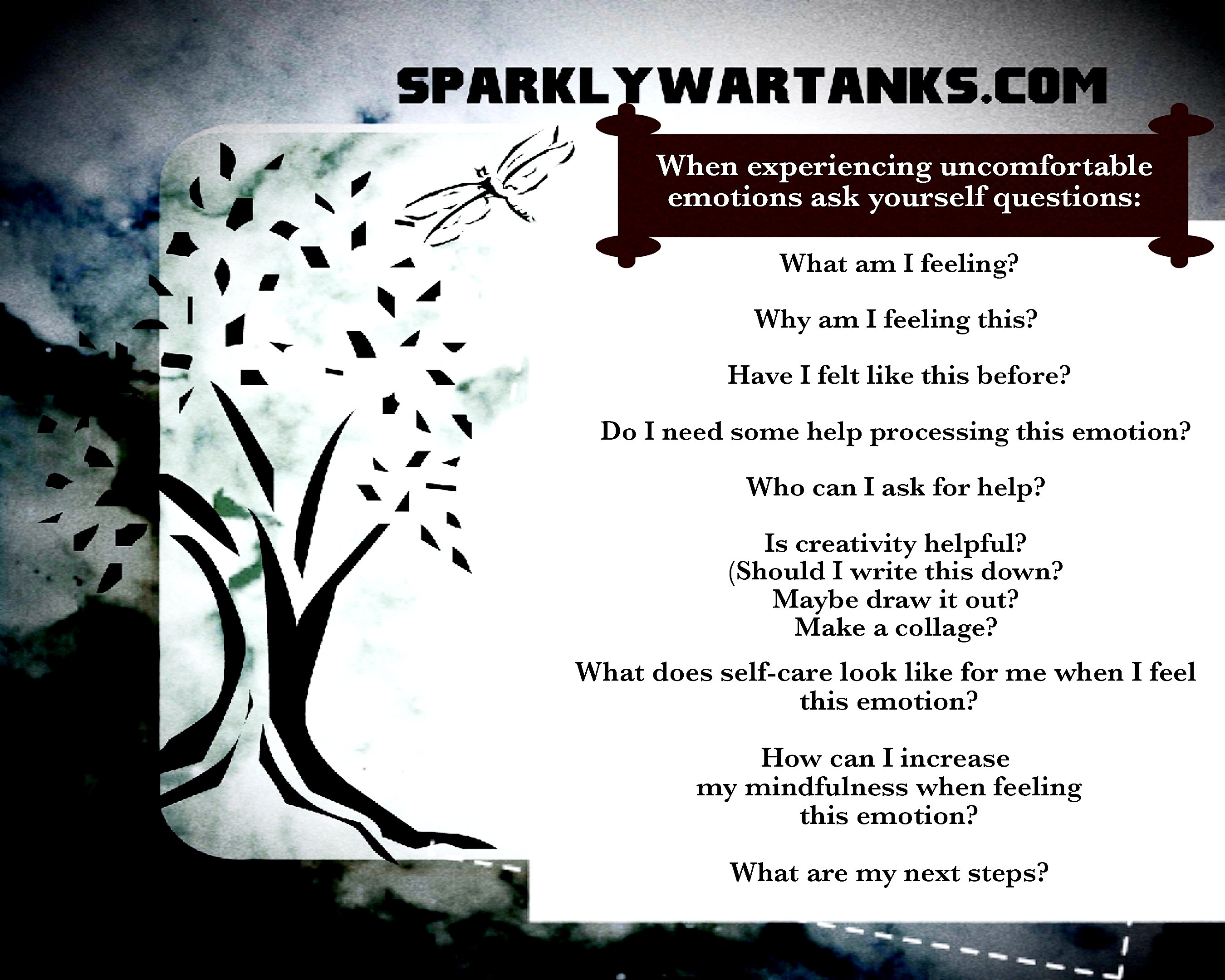
When experiencing uncomfortable emotions ask yourself questions:

  • What am I feeling?
  • Why am I feeling this?
  • Have I felt like this before?
  • Do I need some help processing this emotion?
  • Who can I ask for help?
  • Is creativity helpful? (Should I write this down? Maybe draw it out? Make a collage?
  • Is this emotion influencing my behavior? Is this behavior helpful or harmful?
  • What does self-care look like for me when I feel this emotion?
  • How can I increase my mindfulness when feeling this emotion?
  • What are my next steps?

**Question graphic! Sticker set will be available in my Etsy shop.**

Experiencing certain emotions can be scary, but allowing yourself to feel shows you how best to support yourself or ask for support.

Feel and not dismiss, reject, or ignore how your body is reacting to your environment and experiences. You can learn so much about yourself by reflecting on what is happening.

Practice self-compassion by giving yourself permission to feel.