Setting goals can be difficult especially if we find ourselves unmotivated or having lots to do. For me, it helps to break up my goals from least likely to accomplish right away to something I can do today.
Activity
This week, let’s focus on our personal goals and ways we can prioritize our self-care.
What is a personal goal you want to set this week?
-What is the goal?
-Why is this goal important to you?
-How can you make sure you prioritize and accomplish this goal?
Reflection
A personal goal that I’m setting this week is honoring my needs by starting my bedtime routine by 11:00 pm. Crippling insomnia has dictated most of this quarantine and I really need to prioritize my sleep so I feel less drowsy and achy the following day.
Join this prompt’s conversation here on The Mighty.
One of the many exiting additions for my group, The Pencil Case, on The Mighty, is Pencil Case Prompts.
The goal of these prompts will be to to think, reflect, contemplate and share.
I will be sharing these prompts here on SparklyWarTanks with a link to the post on The Mighty!
Note: Pencil Case prompts are journaling prompts you can use for personal journaling or to answer in the comments for The Pencil Case Prompts posts. The prompt will always have two follow up question: What and Why to help us turn our thinking caps on!
Prompt 1
One thing that helps me to keep going is to remember random moments where I felt good. Some of those moments are moments where I accomplished/achieveved something and felt proud of myself or recalling my talents and things only I can do the way I do it.
Activity
What is an accomplishment, achievement or talent you are proud of?
What is the accomplishment, achievement, or talent?
Why is it important to you?
Note: There is nothing too big or too small to mention as an accomplishment, achievement, or talent.
Reflection
I know I mention this ALL THE TIME but I’m so proud of myself for 1. starting my brand and 2. expanding my brand to Motivation by SparklyWarTanks.
There was a point in my life where I didn’t think I would be anything or do anything worth mentioning. Being able to continuously work on something helps me in my darkest loneliest moments to remind myself that I CAN do what I SAY I can do.
Join this prompt’s conversation on The Mighty here.
“Self-acceptance is a process with no time limit or expectation. We are always growing, evolving, and learning. Once we’ve reflected and asked ourselves important questions to grow in self-awareness, we can now put our continuous acceptance into practice.”
So this post appeared on my Facebook feed and allowed me to reflect on the previous conversations I’ve had with my therapist. Conversations centered around relationship-building, relationship maintenance, and relationship termination. Relationship in this sense is defined by any bond I make with who I’ve come to encounter.
Relationships (whether platonic or romantic) are complex and whether we choose to remain in such interactions with others is what we have control over. We have control over who we surround ourselves with.
Still, while in my current frustrations, I’ve realized my habit of “holding space” although torn between whether im valued or thus appreciated in such bonds. When do I draw a line between moving past and holding space? In what ways can I hold space while also ensuring my needs are met and I feel the relationship is benefiting both parties?
Holding space is a form of love and acceptance. And while this year, in particular, has shown me my own strength in my “space holding” capacities, I do value this part of me. I hold space because I love my friends, family (actual, internet, from school or in other instances) and I choose to make room for them. Make room in how I love and support those who’ve shown me vulnerable parts of them.
And yes. Making space isn’t easy as everyone is different and I can’t control others’ “space holding” capacities, only my own. To become frustrated and rash is how I’ve come to include my own needs and put myself in the equation too. Holding space doesn’t mean I won’t get frustrated, triggered, or annoyed. Neither does it mean I’ll abandon myself in pursuit of others’ needs, but I still will make space as well as hold space.
To the people that I love and cherish, there is always space for you. I love you and will always have space in my love for you. If we’ve fallen out or hurt one another in some ways I still have space and I’m rooting for you wherever you are. If we’ve just got to meet one another and getting to know the complexities of one another’s character, my space is here and isn’t going anywhere. And as I hold space for others, my only desire is that others will also hold a space for me.
Off.
Leave.
Attachment.
Abandonment.
Neglect.
Cold.
My heart feels cold.
I give up.
I let go.
I don’t want you.
I don’t need you.
I come back to myself.
I’m first.
I’m all I have.
I’m all I need.
Cold.
My heart feels cold.
Busyness is how some of us distract ourselves from our thoughts and trauma. With so much to do, there is often no time to stop, reflect, and build a relationship with ourselves. In times of isolation, however, it’s more difficult to combat and dismiss the impulse of intrusive thoughts. This may even be the first time some are alone with their thoughts and can’t immediately turn to “doing” to deflect negative patterns of thinking.
What do we do when experiencing an overwhelming spiral of intrusive thoughts?
Acknowledge the thought. Ask yourself, Is this thought familiar?
Identify the feelings the thought brings up. How am I feeling? Why am I feeling this?
Turn to a productive perspective to address spiraling. Is this thought true or intrusive?
Reassure yourself that you are doing the best you can and practice self-compassion. What is triggering this thought and what can I do to help myself reframe/dismiss this thought.
Write down what you are thinking or feeling. How intense is what I’m experiencing?
Ask for help or talk to someone you trust to get a different perspective.
Building a sense of self-awareness takes time and patience. There may even be parts of ourselves we may encounter for the first time and that’s okay. We are all multifaceted. Building a relationship with who we are is important.
This may be the first time we find ourselves actually reflecting, but that doesn’t mean we can’t grow and learn to love all parts of ourselves.
If I were to tell you that the lists of things you’ve done, the relationships you have, or the job titles you’ve held don’t make you who you are, would you believe me? If I were to tell you that you are whole just because, would you think I’m wrong?No matter what we do or who we think we have to become we are fundamentally valuable and worth living every single day. It doesn’t matter how much we get done, or how much we’ve been through, every day we wake up we hold the power of our value and worth and that never changes.”I am” despite of anything that follows that statement.
It’s been a really rough 2020 already. It’s tried to knock you down, step on you, and declare your defeat. What 2020 doesn’t know is you already declared that no matter what, you will figure out how to bounce back EVERY SINGLE TIME. No matter how complicated or complex the struggle, nothing will overcome your resilience.
I know you’re hurting but I also know you learned so much through the pain you endured.
You learned that:
It’s okay to be sensitive.
It’s okay to cry and express emotions.
Learn early how to love and accept yourself.
You are different and that fact will catalyst your passion.
People will look out for themselves.
Put yourself first because no one else will.
You are not like everyone, your self-care looks different.
You don’t need to be with someone to be whole.
Your empathy is powerful, build it up.
You have a soft and gentle spirit, protect yourself, learn how to say no.
Your mind will tell you a lot of lies, declare your power and control over yourself.
People have their own trauma and will show it through their behavior, do not take it personal.
Self-awareness is scary but necessary.
Your mind is very very powerful, use it to create and influence change.
Your purpose is beyond what you can fathom, manifest it with all of your being.
Depression and anxiety will not defeat you.
It’s taken some time to learn these lessons, and probably would have been helpful growing up, but you know now and that’s what’s important. You know that your life is valuable although you may feel tortured sometimes. Keep that smile on your face because its beyond beautiful.
Despite the pain, the tears, and the loneliness, you have a job to do. Get up and keep going.
A boundary is a limit or rule we set for ourselves to honor our inner and outer well-being. Whether that boundary is to protect ourselves, to reserve energy, resources and money, to stop ourselves from the urge to continuously give or “save” another, or simply to respect our personal goals and self-worth, it’s essential to build and maintain personal boundaries.
Personal boundaries are what separate us from giving too much of ourselves to things, people, and situations that do not serve our growth and progress. While it may appear ideal to be able to do everything and anything without limits, we cannot and should not exhaust ourselves of our personal needs. We are responsible for what we allow. Whether in relationships (familial or romantic), with friends, at work, or anywhere where we are interacting with others, practicing boundaries helps us to be in tune with ourselves and our values.
Something to Remember: We are not perfect and cannot do everything or please everyone at the expense of our mental, physical, or emotional well-being.
How can we, therefore, set boundaries that will help us prioritize our needs?
Self-Awareness and Boundary Setting
Increasing self-awareness is an important step when building and maintaining personal boundaries. The more we know who we are and what we are okay with, the more we can establish and sustain boundaries that serve us best. Understanding the balance between too much, too little, and the right amount of energy and effort can push us in the right direction in creating healthy boundaries.
Here are some questions you can ask yourself that will help you reflect and understand whether you need to set stricter boundaries:
How do I feel?
How would I rather feel?
Should I say no?
Do I have time to spare?
Does this make me feel uncomfortable?
Is this benefiting me?
Am I overexerting myself?
Do I need to do this?
Do I want to do this?
Can I do this?
Do I need time for myself?
What is okay/not okay for me to do/say?
When do I speak up?
Does something need to end?
What can I change?
What do I have control over?
Getting into the habit of asking questions is not only a good idea for self-awareness, but also for increasing confidence. Becoming reflective in understanding what we deserve and in what we will tolerate will also aid in a better understanding of self-worth.
How Boundaries Help Strengthen our Mental Health
Boundaries allow us to build a stronger connection with ourselves. Understanding who we are will help us to become more centered and mindful of what is happening around us and to us. Stern boundaries will also help us to prioritize self-care, become more direct and open as well as vocal about our needs, beliefs and values. Being able to say no and express how we feel will give us the autonomy we need to improve our sense of self-worth. We will feel more comfortable expressing ideas and thoughts without shame, embarrassment, or hesitation.
Healthy boundaries can look like saying no when necessary, balancing self-care with work, cutting ties with toxic people and situations, speaking up without feeling like a burden, putting your needs before anyone else’s unapologetically, accepting that you cannot change or save anyone and not trying to, and giving yourself permission to feel and reflect without the opinion of others.
Affirmations to help Maintain and Sustain Positive Personal Boundaries:
I set standards for myself and will stick to them.
I know who I am and what is good for me.
I understand my personal boundaries.
I honor myself and my boundaries.
I have a right to my feelings.
I can firmly state my boundaries.
I am confident in my ability to set boundaries with others.
I will say no when necessary.
I am safe.
I am in control of my life.
Next Steps and Final Thoughts
As we move into a space of self-acceptance and self-awareness remember to honor your boundaries and give yourself permission to grow and reflect on your needs. Continuously grow in your boundaries in love and compassion for yourself.
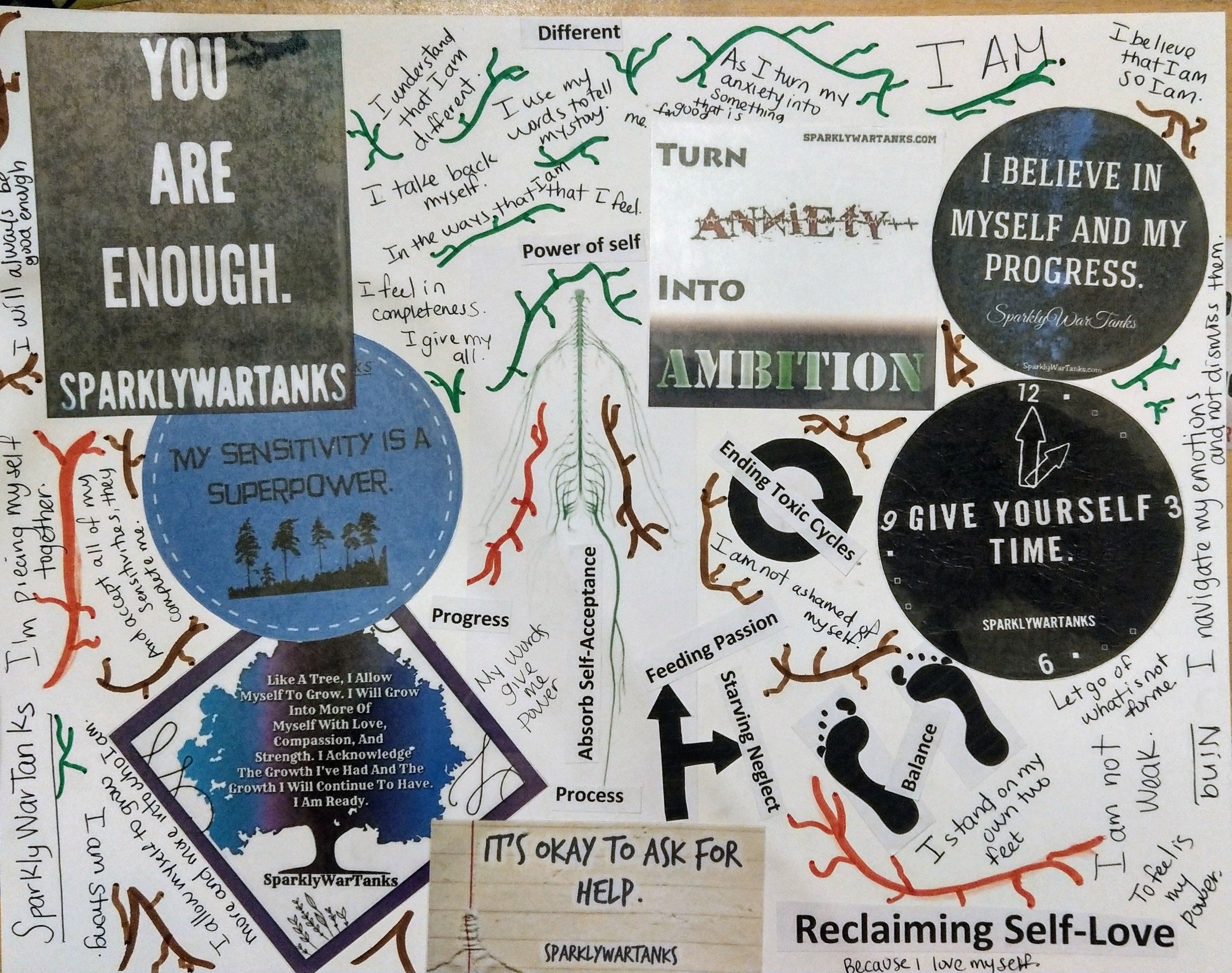
A collage depiction of what self-love looks like inside of me, traveling through my veins.
Going Back to Therapy
For the last month and a half or so I’ve been seeing a therapist for the first time since that one semester in my senior year of college. Although it’s difficult to manage all the emotions that come up as I talk through all of “my stuff”, I’m continuing to come in contact with the parts of me that were previously tucked deeply away. The more I talk and navigate my experiences, the more I’m able to identify the parts of me that need healing.
In these few weeks I learned three big things about my personality, habits, and tendencies:
1. I’m a highly sensitive person and a hopeless romantic.
2. I have issues with feeling good enough and loving myself in the same intensity that I love others.
3. I’m a recovering perfectionist and still struggle with “doing” too much to feel seen. I try to “stay busy” in order to distract myself from feelings unlovable, worthless, and enough. I crave outside stimuli to try to fill a void inside.
The Creative Cure
As I’m learning about what it means to be me, the good and the bad, I found that creativity and writing are my most helpful tools for feeling better.
Because I’m aware of my perfectionism, I’m trying to reverse and redirect the energies I put in “doing”, “pleasing” and “overexerting” back into myself. As I practice what feeds my passion, I’m beginning to realize what love means for me. The more I see what love is for me, the more I can pour back into myself the void of practicing and feeling self-love.
Passion and Learning Self-love
Passion is the manifestation of self-love — It’s love in doing. Passion is one of the only feelings (along with ambition, for example) that can not be given to someone else. To feel passion is to come in contact with something in yourself that feeds your needs and fuels your purpose.
When I create, write, and tell my story I feel passion. Doing what I feel passion for allows me to access peace and satisfaction perfectionism never can.
As I move closer to reclaiming my self-love, allowing it to travel to all parts of me (including my perspective of myself), I will use writing and creativity to help heal me of my self-love wound.
Some Advice
Find your passion. Find what helps you feel good and accomplished. Learn about yourself and learn what love means to you. Feel and access the energy of love. Once you’ve found the peace that comes with love, you can practice love for yourself and with others.
Self-care with unbreakable self-love is powerful and can help you build a healthier you.






 If I were to tell you that the lists of things you’ve done, the relationships you have, or the job titles you’ve held don’t make you who you are, would you believe me?